

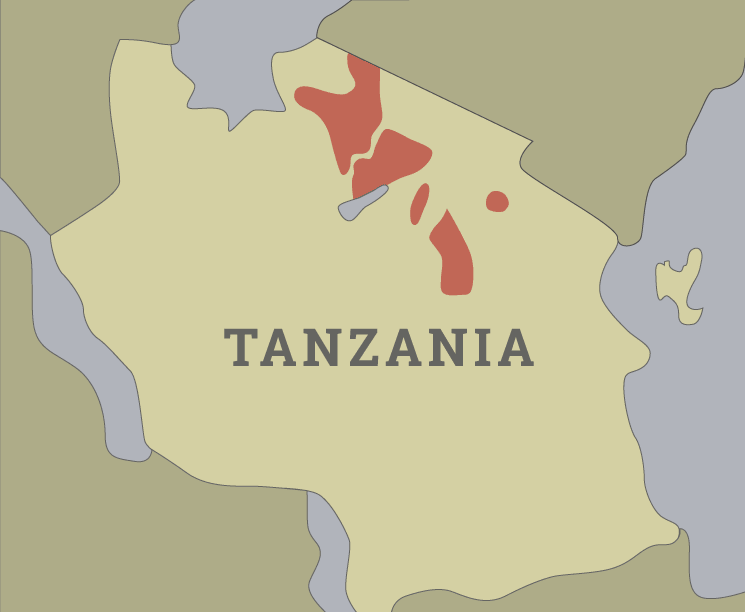
Weather
The weather in September is dry and sunny. The landscape is parched
as the dry season has completely taken hold. The long grasses have died
back, which makes game viewing easier and many of the animals congregate
in the woodlands and around the remaining sources of water.
Temperatures are pleasant with an average high of 81 degrees and an
average low of 55 degrees. However, the rim of the Ngorongoro Crater
can get quite cold at night and in the early morning. Visitor numbers
increase dramatically over July and they peak in August. Visitor numbers
are at their highest in August but drop off dramatically in mid to late
September. The good news is that the vast majority of people are on
package tours staying at the main lodges and zipping around the main
roads in only a few popular areas. With careful planning we can customize
your safari so you will encounter more lions than people in even the
busiest months.
Seasonal Wildlife Highlights
Serengeti National Park
Northern Serengeti (Woodlands)
September Recommended Duration of Game Drives: 1 - 2 Days
September Wildlife Highlights: Wildebeest Migration, Zebra Migration,
Lion, Hyena, Elephant, Giraffe, Impala, Buffalo, Hippo
As the plains dried out sometime in May or early June, the wildebeest
and zebra migration moved north and west off the plains into the Western
and Central Serengeti. During June many wildebeest occupied their transitional
zone in the Western Serengeti. Other herds of wildebeest and zebra began
to move directly north through the Central Serengeti. As the dry season
progressed in July, the great herds continued to shift northward towards
the Northern Serengeti and the Masai Mara in Kenya. Zebra tend to reach
the Northern Serengeti sometime in early July while the wildebeest herds
usually begin to appear in the Northern Serengeti towards mid July and
do not usually reach the Masai Mara until early August.
By September, the main herds of both migratory wildebeest and zebra
will likely be located in the watershed area of the Masai Mara in Kenya.
Typically, the main wildebeest and zebra herds will be located in the
Masai Mara from early August to early October. During the beginning
of October, they reverse course as they come flooding down the northern
corridor to the Serengeti plains.
Though a significant portion of the herds will be located across the
border in August and September, there will still be plenty of wildebeest
and zebra dispersed throughout the Northern Serengeti. In addition,
significant portions of the migration can usually be accessed with game
drives to the extreme north of the Serengeti up to the Bologonja Gate.
It is possible to game drive to within a few miles of Kenya where you
will likely encounter large herds. This makes Kleins Camp, Migration
Camp or the northern campsites in a prime position from mid July through
early November.
A good alternative to the Northern Serengeti in August and September
is to incorporate a 3-night extension to the Masai Mara if seeing the
migration is a priority. Please see the Masai Mara extension for further
information. The Mara extension can be used as a replacement for the
Northern Serengeti or as a compliment.
The northern region of the Serengeti is a vast pristine area of wooded
rolling hills interspersed with open grassy patches and large granite
outcrops. This region extends north about 55 miles from Seronera in
the Central Serengeti to the Masai Mara Game Reserve in Kenya. Most
visitors to the Serengeti never see the northern region. It is only
rarely visited and remains an unexplored and untouched wilderness packed
with stunning landscapes and large concentrations of wildlife during
the dry season.
The Northern Serengeti supports a good number of resident herbivores
including giraffe, hippo, topi, impala and Thomson’s gazelle.
This area is home to the largest remaining concentrations of elephants
and buffalo in the Serengeti. All four large carnivores (lion, leopard,
cheetah and hyena) are also resident in the Northern Serengeti.
Mid July through early November is the absolute best time to visit the
Northern Serengeti. The Northern Serengeti is a must see during these
months. Hundreds of thousands of wildebeest and zebra may even be passing
through the immediate area as they make their way southward or northward
depending on the exact time of your visit and current rainfall patterns.
If you are unable to locate the large herds, wildlife viewing will still
be excellent as the northern corridor supports large amounts of resident
herbivores and carnivores. The resident animal action is especially
good during the dry season months.
Western Serengeti (Woodlands)
September Recommended Duration of Game Drives: 0 - 1 Day
September Wildlife Highlights: Giraffe, Impala, Hippo, Resident Wildebeest
and Zebra
The Western Serengeti is home to significant numbers of resident wildlife.
There are large populations of resident wildebeest and zebra that do
not join their migratory cousins as they pass through every year on
their journey northwards. Other resident animals include giraffe, buffalo,
eland, topi, impala, waterbuck and Thomson’s gazelle. These resident
animals support good concentrations of predators including lion, leopard,
cheetah and hyena. The big cats are frequently sighted but not to the
extent as seen in the Central Serengeti. The Western Serengeti is at
its best from late May to Mid July.
During August through October, we recommend to focus your safari on
the Northern Serengeti instead of the Western Serengeti. Game viewing
will be better in the Northern Serengeti during these months. Additionally,
the Central Serengeti and Tarangire are a must see in September. Given
that better quality and more abundant game viewing is available in so
many other areas during August through October, the Western Serengeti
is only recommended on longer safari itineraries. A good option on longer
September safari itineraries is to incorporate a day drive into the
western corridor while staying in the Central Serengeti. This will enable
you to quickly see the West while still focusing on the better game
viewing areas in the Central and Northern Serengeti.
Central Serengeti (Plains/Woodlands Border)
September Recommended Duration of Game Drives: 2 - 3 Days
September Wildlife Highlights: Thomson’s Gazelle Migration, Cheetah,
Leopard, Lion, Giraffe, Impala, Buffalo, Hippo
The Central Serengeti offers superb game viewing year round due to its
abundance of resident animals. Specifically, the Seronera River Valley
in the Central Serengeti is a ‘must see’ on every safari
regardless of the specific month of travel. Many of the non-migratory
or resident animals will be concentrated in the Central Serengeti, which
provides a dry season refuge, as it forms the main plains/woodlands
boundary. Resident lions will be abundant here as they take advantage
of the animal concentrations around the permanent sources of water.
Cheetahs will also be in abundance as they have followed the migratory
gazelles from the plains into the woodland/plains border of the Central
Serengeti.
Game viewing in Central Serengeti is at its best during the dry season
(June - November) as resident animals are more concentrated in the immediate
area due to the lack of water on the plains. Resident herbivores include
impala, buffalo, hippo, warthog, topi, hartebeest and giraffe. Resident
carnivores include lion and leopard.
In addition to the resident wildlife, significant concentrations of
migratory animals are found in the Central Serengeti during the dry
season including cheetah, Thomson’s gazelle and hyena. The Thomson’s
gazelles migrate to the eastern short grass plains during the wet season
and then back to the Central Serengeti during the dry season. The majority
of the cheetahs in the Serengeti are also migratory in that many of
them follow the Thomson’s Gazelle migration. Additionally, hyenas
are semi-nomadic and many of them can be found in the Central Serengeti
during the dry season, where the majority of their den sites are located.
During the wet season, they ‘commute’ to the Eastern Plains
to take advantage of the abundance of animals found on the plains during
this time. Accordingly, you will likely encounter an array of resident
animals plus migratory gazelles, cheetahs and hyenas from about June
to November in the Central Serengeti.
There are 12 documented resident lion prides just within a one-hour
game drive radius from Seronera. During the dry season, the resident
prides begin to shift west and north in their territories and concentrate
in the central region of the park. The dry season is a particularly
good time for lion viewing in the Central Serengeti.
The Seronera Valley in the Central Serengeti is also one of the best
areas in Africa to spot the elusive leopard. You will likely encounter
this majestic cat in the branches of the sausage trees that dot the
banks of the Seronera River.
Eastern Serengeti (Plains)
Not recommended during September.
Southern Serengeti (Plains)
September Recommended Duration of Game Drives: 0 - 1 Day
September Highlights: Walking Safari and Cultural Interactions
The Southern Plains of the Serengeti are extremely seasonal. During
the dry season, you will likely encounter only a few hearty Grant’s
gazelle and the occasional giraffe. However, the southern plains come
to life in the wet season (November - mid June) and offer unparalleled
game viewing.
By September, water has usually become scarce out on the southern plains
and the vast grasslands have been reduced to stubbles forcing the great
herds to the woodlands. The southern plains dry out quickly due to the
shallow soil base and the migratory animals tend to depart quickly.
During the dry season (including September) when the migratory animals
have moved off the southern plains and into the woodlands, we recommend
a one-night stopover (as time permits) on your way from the Central
Serengeti to the Ngorongoro Crater. A night in the southern plains will
provide for excellent walking and hiking options, cultural interactions
with the Maasai and a chance to explore this beautiful part of the Serengeti
ecosystem. The southern plains of the ecosystem in the Ngorongoro Conservation
Area (NCA) offer the best walking safari options and cultural opportunities.
Olduvai Camp, located on the southern plains of the NCA, is the ideal
place to spend a night if you are interested in the aforementioned activities.
More Serengeti National
Park Information.
Ngorongoro Crater
September Recommended Duration of Game Drives: 1 - 2 Days
September Wildlife Highlights: Black Rhino, Elephant, Buffalo, Lion,
Cheetah
The Ngorongoro Crater, described as one of the wonders of the world,
is an amazing natural sanctuary not to be missed. Game viewing here
is among the very best Africa has to offer and is excellent at any time
of year. The crater is very small at only about 10 miles across. With
just one game drive in the Crater, it is possible to circumnavigate
the crater several times and see all the main highlights. However, every
safari we offer includes two separate game drives in the Crater over
a course of two days including one early morning 6AM drive. The goal
on the early morning game drive is to be the first person in the Crater
that day. Animals are generally more active in the morning, which makes
the early morning game drive option an excellent choice.
The crater is not a self-contained ecosystem and some animals do migrate
in and out of the surrounding NCA but not in any significant numbers
to warrant tailoring your itinerary. The main factors for planning are
weather and visitor numbers. The weather will be pleasant in September
and visitor numbers will be moderate. More Ngorongoro
Crater Information.
Tarangire National Park
September Recommended Duration of Game Drives: 2 - 4 Days
September Wildlife Highlights: Elephant, Wildebeest, Zebra, Lion, Giraffe,
Impala, Raptors
At 1,600 square miles, Tarangire National Park is much smaller and lesser
known than its famous neighbors to the north. However, during the dry
season wildlife concentrations rival that of the Serengeti. The wildlife
rhythms of Tarangire are almost directly opposite to those of the Serengeti.
Tarangire comes into its own during the dry season (July - November)
when enormous populations of elephants and other animals are drawn to
the Tarangire River and other sources of permanent water within the
park. During the wet season, many of the animals disperse into the surrounding
areas of the greater ecosystem.
During June, the surrounding areas are beginning to dry out and many
of the animals will begin to migrate back into Tarangire from the greater
ecosystem. The large herds of wildebeest, zebra and elephants start
to appear usually sometime in June. During July, the surrounding areas
have almost completely dried out and many of the animals have migrated
back into Tarangire from the greater ecosystem.
By September, the outlying areas are parched and thousands of animals
will be concentrating in and around the Tarangire River. August, September
and October are the very best months to visit to Tarangire. Game viewing
will be phenomenal.
Massive herds of buffalo, wildebeest and zebra will be congregating
around the remaining rivers and swamps from August through October.
Elephant viewing will be outstanding and it is likely that you will
see over 200 of them on a single game drive. Elephant concentrations
at this time rival that of any park in Africa.
The massive concentrations of animals combined with the spectacular
scenery will surely make for a memorable visit during September. Expect
to also see giraffe, impala, warthog, dik-dik and several species of
large raptors. With a little luck you will also encounter a leopard
and some of the rarer antelopes including elands, kudus and oryx. This
is the favorite time of year for the lions of Tarangire as their main
quarry, wildebeest and zebra are in abundance. Lion prides are much
more stationary during the dry season and can readily be found by the
remaining rivers, springs and swamps. Tarangire is a must see on every
safari from mid July to late November. More Tarangire
Information.
Lake Manyara National Park
September Recommended Duration of Game Drives: 0 - 1 Day
September Wildlife Highlights: Elephant, Baboons, Giraffe, Impala, Birding
Game viewing is generally fair to good in Lake Manyara at any time of
year. However, Lake Manyara does not offer the abundance of wildlife
nor quality of wildlife viewing experiences found in the other parks
of Northern Tanzania. Similar to Ngorongoro Crater, seasonal wildlife
patterns are not significant enough to warrant tailoring your itinerary.
Lake Manyara is a beautiful little park and is famous for its tree-climbing
lions, elephants and large troops of baboons. The park is home to an
amazing variety of birds and animals considering its small size. A short
visit to this serene park will greatly diversify your safari experience
as the lush green jungle habitat is of stark contrast to the other parks
you will visit during your safari.
We find that a quick day visit to Lake Manyara before either heading
back towards Kilimanjaro or on the way from the Crater to Tarangire
is sufficient and ideal for most travelers. The park gate is just a
few feet from the main road and this combined with the fact that the
park is small allows for quick and rewarding forays into the park. A
one to four hour visit to Lake Manyara makes a superb addition to any
safari itinerary. More Lake
Manyara Information.
Select another month:
JANUARY
MAY
SEPTEMBER
FEBRUARY
JUNE
OCTOBER
MARCH
JULY
NOVEMBER
APRIL
AUGUST
DECEMBER