

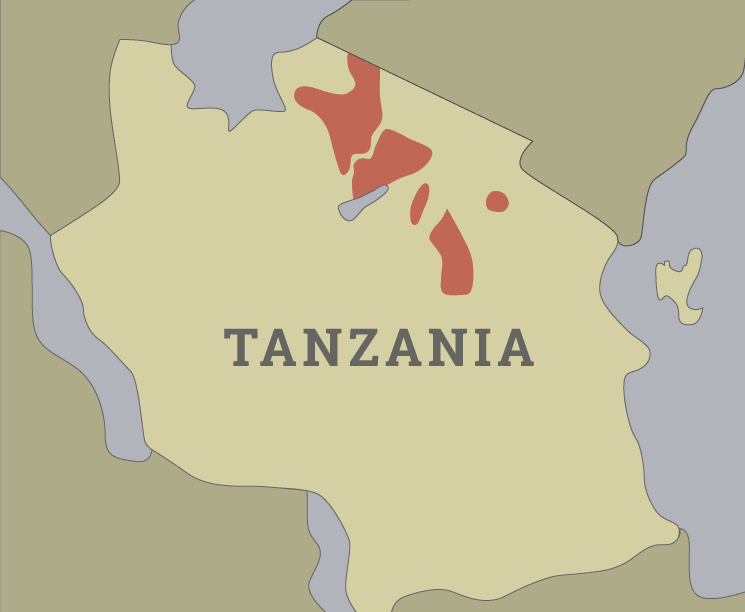
Weather
Early June marks the beginning of the dry season, which lasts from about
the end of May to the end of October. By early June, the skies have
cleared and all the parks have begun their season of change. The landscape
changes dramatically as the parks dry out starting first with the plains
and last with the woodlands. The weather will be mostly sunny with only
a slight chance of rain.
Temperatures are pleasant with an average high of 81 degrees and an
average low of 56 degrees. However, the rim of the Ngorongoro Crater
can get quite cold at night and in the early morning. Visitor numbers
drop off dramatically at the beginning of March and during April and
May the parks are completely empty of tourists. Visitor numbers are
still low in the beginning of June but begin to rise to moderately high
numbers at the end of June.
Seasonal Wildlife Highlights
Serengeti National Park
Northern Serengeti (Woodlands)
Not recommended during June.
Western Serengeti (Woodlands)
June Recommended Duration of Game Drives: 1 - 2 Days
June Wildlife Highlights: Wildebeest Migration, Lion, Giraffe, Impala,
Crocodile, Hippo
The western corridor straddles the northward migration route of the
wildebeest migration. Typically in mid May (the end of the wet season),
the great herds will depart the southern and eastern Serengeti plains
and begin their long journey around the Serengeti ecosystem in search
of greener pastures. The northward wildebeest migration is divided between
two main population groups that have two different northward migration
routes. The first and largest group follows the Mbalageti and Seronera
Rivers from the southern plains into the western corridor. These herds
will remain in the northern reaches of the western corridor until about
July when the dry season completely parches the land and they must venture
north towards Kenya and its greener pastures. The second main group
heads directly north from the plains through the Central Serengeti and
directly into the Northern Serengeti and Masai Mara without entering
the Western Serengeti.
By June, water has become scarce out on the plains and the vast grasslands
have been reduced to stubbles. The great herds and many other animals
have been forced to the woodlands for foraging and water. The migration
should be in full swing as the herds make their way from the plains
to their transitional range located in the Western Serengeti. The mass
movements of the migration combined with the continuation of the wildebeest
rut in the beginning of June makes this an exciting time for a safari
in the Serengeti. Predators will also be highly visible as some follow
the migration and other resident ones take advantage of this time of
plenty. The Western Serengeti is the place to be in June. It is the
very best time to visit the Western Serengeti and game viewing should
be spectacular. This makes Kirawira and Grumeti River Camp in a prime
position to catch all the action.
The Western Serengeti is also home to significant numbers of resident
wildlife. There are large populations of resident wildebeest and zebra
that do not join their migratory cousins as they pass through every
year on their journey northwards. Other resident animals include giraffe,
buffalo, eland, topi, impala, waterbuck and Thomson’s gazelle.
These resident animals support large concentrations of predators including
lion, leopard, cheetah and hyena. The big cats are frequently sighted
but not to the extent as seen in the central Serengeti.
Central Serengeti (Plains/Woodlands Border)
June Recommended Duration of Game Drives: 1 - 3 Days
June Wildlife Highlights: Wildebeest Migration, Zebra Migration, Thomson’s
Gazelle Migration, Cheetah, Leopard, Lion, Giraffe, Buffalo, Hippo
The Central Serengeti offers superb game viewing year round due to its
abundance of resident animals. Specifically, the Seronera River Valley
in the Central Serengeti is a ‘must see’ on every safari
regardless of the specific month of travel.
Game viewing in Central Serengeti is at its best during the dry season
(June - November) as resident animals are more concentrated in the immediate
area due to the lack of water on the plains. Resident herbivores include
impala, buffalo, hippo, warthog, topi, hartebeest and giraffe. Resident
carnivores include lion and leopard.
In addition to the resident wildlife, significant concentrations of
migratory animals are found in the Central Serengeti during the dry
season including cheetah, Thomson’s gazelle and hyena. The Thomson’s
gazelles migrate to the eastern short grass plains during the wet season
and then back to the Central Serengeti during the dry season. The majority
of the cheetahs in the Serengeti are also migratory in that many of
them follow the Thomson’s Gazelle migration to the Central Serengeti
during the dry season. Additionally, hyenas are semi-nomadic and many
of them can be found in the Central Serengeti during the dry season,
where the majority of their den sites are located. During the wet season,
they ‘commute’ to the Eastern Plains to take advantage of
the abundance of animals found on the plains during this time. Accordingly,
you will likely encounter an array of resident animals plus migratory
gazelles, cheetahs and hyena from about June to November in the Central
Serengeti.
There are 12 documented resident lion prides just within a one-hour
game drive radius from Seronera. During the dry season, the resident
prides begin to shift west and north in their territories and concentrate
in the central region of the park. The dry season is a particularly
good time for lion viewing in the Central Serengeti.
The Seronera Valley in the Central Serengeti is also one of the best
areas in Africa to spot the elusive leopard. You will likely encounter
this majestic cat in the branches of the sausage trees that dot the
banks of the Seronera River.
In addition to the Western Serengeti, the Central Serengeti is located
on the northward migration route for a significant proportion of the
wildebeest herds. It is also located on the main path for the migratory
zebra herds. The zebra migration differs from the wildebeest migration
in that the zebra take a more northerly departure off the plains. Many
move directly north through the Central Serengeti and towards Kenya
without entering the Western Serengeti.
Overall, June is the best month of the year for game viewing in the
Central Serengeti with the migration pouring through plus the array
of resident animals. It is certainly the favorite month for the resident
lion prides of the Central Serengeti.
Eastern Serengeti (Plains)
June Recommended Duration of Game Drives: 1 Day
June Wildlife Highlights: Cheetah, Hyena, Eland Migration, Thomson’s
Gazelle Migration (early to mid June only)
The Eastern Plains of the Serengeti are extremely seasonal. During the
dry season, you will likely encounter only a few hearty Grant’s
gazelle. However, the eastern plains come to life in the wet season
(November - mid June) and offer incredible game viewing for certain
species of animals. A day trip at the minimum should be included in
every green season itinerary. June is a tough time to call for wildlife
viewing on the eastern plains. Depending on the cessation of the rains,
the eastern plains will dry out sometime between about mid May to mid
June. These eastern plains dry out quickly due to the shallow soil base
and the migratory animals tend to depart quickly. Accordingly, it is
usually hit and miss through mid June. By late June, the eastern plains
will likely be devoid of wildlife.
The GOL Kopjes, located on the Eastern Plains, boasts the highest concentrations
of cheetahs in Africa during the wet season. The majority of the cheetahs
in the Serengeti are migratory in that many of them follow the Thomson’s
Gazelle migration to the eastern short grass plains during the wet season
and then back to the Central Serengeti (plains/woodland border) during
the dry season.
The Eastern Plains are also the main wet season range of the giant eland
migration. Additionally, you will likely find large clans of hyenas
numbering up to 30 individuals in a single group. Hyenas are semi-nomadic
and ‘commute’ to the Eastern Plains during the wet season
from their den sites located in the Central Serengeti.
East of the Serengeti way out beyond the GOL Kopjes are the Eastern
Plains of the Ngorongoro Conservation Area. Hundreds of thousands of
migratory wildebeest range both the southern and eastern plains. You
will likely encounter thousands of wildebeest from the GOL Kopjes, east
through Angata Kiti and into the Salei Plains by the active volcano
Mount Lengai. This is an extremely beautiful and remote area of the
Eastern Plains and if you are adventurous enough to visit you will be
rewarded with superb off the beaten track game viewing.
Southern Serengeti (Plains)
June Recommended Duration of Game Drives: 1 Day
June Wildlife Highlights: Wildebeest Migration and Zebra Migration,
Lion, Cheetah, Elephant (early June only)
By mid June, water has usually become scarce out on the southern plains
and the vast grasslands have been reduced to stubbles forcing the great
herds to the woodlands. Depending on the cessation of the rains, the
southern plains will dry out sometime between about mid May to mid June.
Similarly to the eastern plains, the southern plains dry out quickly
due to the shallow soil base and the migratory animals tend to depart
quickly. Accordingly, it is usually hit and miss through mid June. By
late June, the southern plains will likely be devoid of wildlife.
The southern Serengeti steals the show in the wet season until about
early June. The life giving rains that generally begin in mid November
and last through early May trigger the great wildebeest migration into
the plains of the South Serengeti and the northern Ngorongoro Conservation
Area. As the rain subsides in May and the grasses have been reduced
to stubbles, the great herds slowly begin to form and start their long
march northward towards their dry season ranges. When the great movement
begins is heavily dependent on rainfall patterns. The most likely scenario
is that in the beginning of May the main herds will be located in and
around the southern Serengeti. By late May they will have begun moving
north-west towards the western corridor with a smaller group moving
directly north. The end of May and early June is also the time of the
spectacular annual wildebeest rut, which is an amazing sight to behold.
During the dry season (including June) when the migratory animals have
moved off the southern plains and into the woodlands, we recommend a
one-night stopover on your way from the Central Serengeti to the Ngorongoro
Crater. A night in the southern plains will provide for excellent walking
and hiking options, cultural interactions with the Maasai and a chance
to explore this beautiful part of the Serengeti ecosystem. The southern
plains of the ecosystem in the Ngorongoro Conservation Area (NCA) offer
the best walking safari options plus the best cultural opportunities.
Olduvai Camp, located on the southern plains of the NCA, is the ideal
place to spend a night if you are interested in the aforementioned activities.
More Serengeti National
Park Information.
Ngorongoro Crater
June Recommended Duration of Game Drives: 1 - 2 Days
June Wildlife Highlights: Black Rhino, Elephant, Buffalo, Lion, Cheetah
The Ngorongoro Crater, described as one of the wonders of the world,
is an amazing natural sanctuary not to be missed. Game viewing here
is among the very best Africa has to offer and is excellent at any time
of year. The crater is very small at only about 10 miles across. With
just one game drive in the Crater, it is possible to circumnavigate
the crater several times and see all the main highlights. However, every
safari we offer includes two separate game drives in the Crater over
a course of two days including one early morning 6AM drive. The goal
on the early morning game drive is to be the first person in the Crater
that day. Animals are generally more active in the morning, which makes
the early morning game drive option an excellent choice.
The crater is not a self-contained ecosystem and some animals do migrate
in and out of the surrounding NCA but not in any significant numbers
to warrant tailoring your itinerary. The main factors for planning are
weather and visitor numbers. In June, the crater will still be somewhat
green and visitor numbers will begin to increase to moderately high
numbers. More Ngorongoro
Crater Information.
Tarangire National Park
June Recommended Duration of Game Drives: 0 - 2 Days
June Wildlife Highlights: Elephant, Giraffe, Impala, Raptors
The wildlife rhythms of Tarangire are almost directly opposite to those
of the Serengeti. Tarangire comes into its own during the dry season
(July - November) when enormous populations of elephants and other animals
are drawn to the Tarangire River and other sources of permanent water
within the park. During the wet season, many of the animals disperse
into the surrounding areas of the greater ecosystem.
By June, the surrounding areas are beginning to dry out and many of
the animals will begin to migrate back into Tarangire from the greater
ecosystem. The large herds of wildebeest, zebra and elephants start
to appear usually sometime in June. Wildlife viewing will be fair to
good as there are moderate numbers of resident animals around. Expect
to see fairly large concentrations of elephants but just not massive
numbers found in the dry season. With a little luck, you might see herds
numbering up to 100 individuals as opposed to the 300 or more strong
herds commonly found in the drier months. Lions are still resident within
the park but they are generally more difficult to find. Though game
viewing will not be at its best, the landscape will be especially beautiful.
Due to the above conditions, we generally only recommend Tarangire for
the curious adventures or for longer itineraries during June. Game viewing
in the Serengeti will be superb during June and we feel that a visit
to Tarangire is usually only warranted on longer safaris. Accordingly,
all of our itineraries up to 8 days do not include Tarangire and only
itineraries 9 days or longer incorporate a few nights in this seasonal
park. However, everything is (as always) completely flexible and we
can include even just one night in Tarangire for any June itinerary.
Feel free to give us a call to discuss whether Tarangire may or may
not be a good choice during June. More Tarangire
Information.
Lake Manyara National Park
June Recommended Duration of Game Drives: 0 - 1 Day
June Wildlife Highlights: Elephant, Baboons, Giraffe, Impala, Birding
Game viewing is generally fair to good in Lake Manyara at any time of
year. However, Lake Manyara does not offer the abundance of wildlife
nor quality of wildlife viewing experiences found in the other parks
of Northern Tanzania. Similar to Ngorongoro Crater, seasonal wildlife
patterns are not significant enough to warrant tailoring your itinerary.
Lake Manyara is a beautiful little park and is famous for its tree-climbing
lions, elephants and large troops of baboons. The park is home to an
amazing variety of birds and animals considering its small size. A short
visit to this serene park will greatly diversify your safari experience
as the lush green jungle habitat is of stark contrast to the other parks
you will visit during your safari.
We find that a quick day visit to Lake Manyara before either heading
back towards Kilimanjaro or on the way from the Crater to Tarangire
is sufficient and ideal for most travelers. The park gate is just a
few feet from the main road and this combined with the fact that the
park is small allows for quick and rewarding forays into the park. A
one to four hour visit to Lake Manyara makes a superb addition to any
safari itinerary. More Lake
Manyara Information.
Select another month:
JANUARY
MAY
SEPTEMBER
FEBRUARY
JUNE
OCTOBER
MARCH
JULY
NOVEMBER
APRIL
AUGUST
DECEMBER